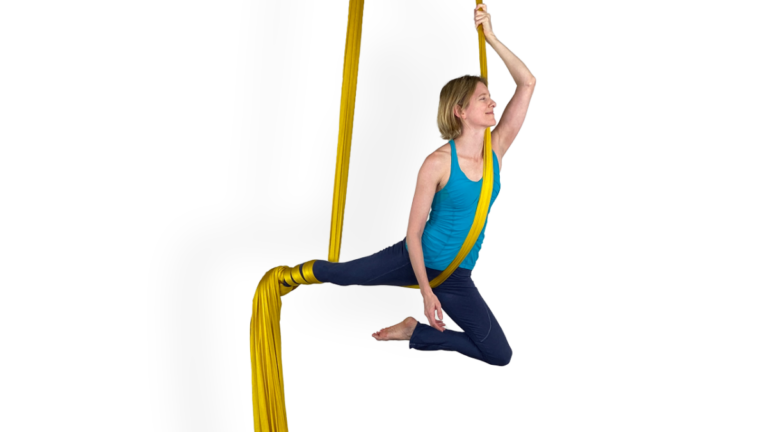
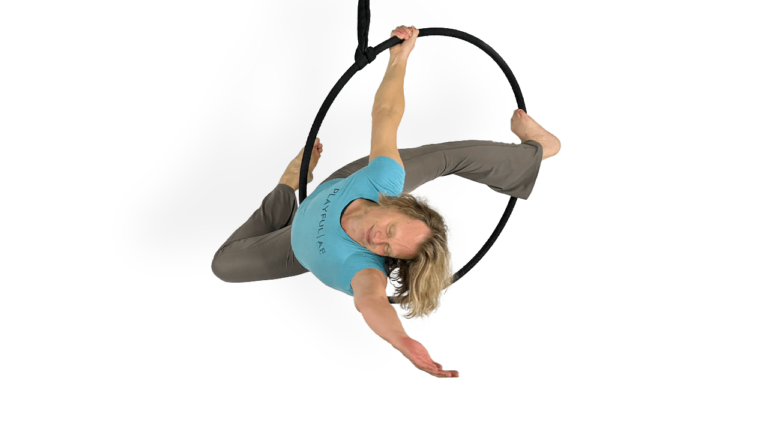
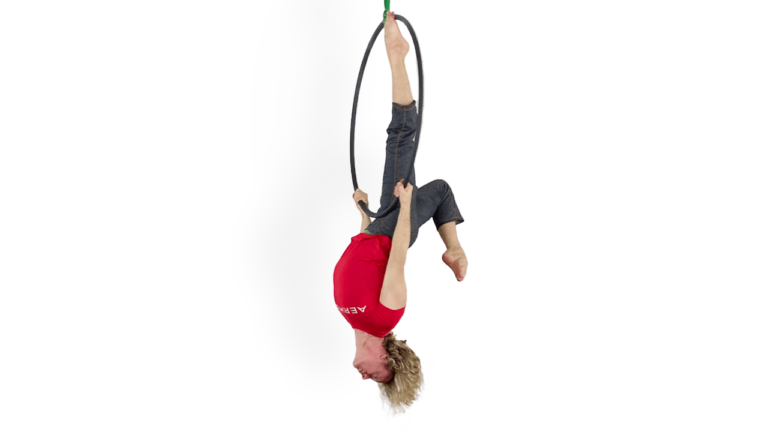
In the aerial classes that we teach, our students will often comment that the prep for the skill was often more challenging than the skill itself. Over the years we’ve heard some iteration of this again and again, and the reason why our students aren’t (usually) struggling with the skills that we teach them is because we prepare them really well with targeted Building Blocks. That means we teach our students a variety of easier skills that incorporate some aspects of the more challenging skill. It’s a win for everyone, because our students learn more material and have more success, and we get to watch them build on each success to take things further.
Last month we talked about how we use a targeted aerial warm-up to prepare our students to succeed with whatever we plan to teach them that day. This article will dive into skill prerequisites (or, what we call Building Blocks), and look at how we specifically work them into our class plan.
Building Blocks can serve many purposes in aerial. Here are the ones we consider most important.
How many instructions can one person hold in their head all at one time? Let’s assume that Skill A (a more basic and simple skill) has 5 really important details to learn. And let’s say Skill B (a more complex or challenging skill) has 10.
Now assume that 5 of the important details in Skill B also exist in Skill A. That means that if we teach Skill A first, our students will only have to learn 5 new details when we move onto Skill B, instead of learning 10 all at once. That makes for easier and faster learning.
In aerial we always prepare our students well for their skills, because we want to make sure they have some physical and mental strength in reserve anytime they’re up in the air. If something goes wrong, a student might need to self-rescue. And often when learning, more strength is required because students are still learning the pathway and technique.
So, when we build up strength both physically and mentally first, then we know our students will be able to safely learn more challenging skills and be ready for any minor mishaps that might occur during the learning process.
When students can see and understand how skills connect, and see similarities among many different skills, it helps them be more self-sufficient in the air. The better we can understand connections, the more we will master our aerial. So constantly pointing out the actions that are similar is really empowering for students who want to take their aerial further, or even just practice outside of class in an open training session.

Candy Cane Roll Up is a skill we teach to our Level 1 students after they have experience in easier footlock skills first. Once they can keep their foot and ankle strong in footlocks, then Candy Cane Roll Up will be much more enjoyable for them.
There is a moment during the Candy Cane Roll Up that is often tricky for new students. It’s the moment when you have to bring yourself up and over the piece of fabric to finish the roll up. Many students think aerial is all upper body and so they try to pull themselves there using their grip and shoulders. But, using the hips and legs to drive this motion makes it infinitely easier and more graceful, and more accessible to more bodies as well!
When we’re planning to teach Candy Cane Roll Up, we first review Standing Side Lean with our students. And we focus on really staying close to the fabric and driving the top hip up and over it.
Then when it’s time to learn Candy Cane Roll Up, we can say something like, “Drive your top hip up and over the fabric like you’re going into your Standing Side Lean. Then continue until you’re belly to the fabric.”
Building blocks can always be used as a warm up skill, but we try to keep things interesting for our students. Instead of just making them do the Building Block skills, we often link them into a brief sequence or present them in a whole new light to make them feel fresh and new.
Building Block Sequences: These sequences don’t need to be performance worthy or profound. Simply linking a few skills together with easy transitions is a great way to get students reviewing building blocks without feeling like they are repeating material. We often surprise ourselves with sequences that actually turn out fun and entertaining for our students. It is fairly common that students enjoy them so much we end up spending more time on them than expected which means we have left over material to use in the next class. Yay for less class planning next week!
Make it fresh and new: We often first introduce skills with a general focus. Unless we are trouble shooting or working with a student with unique needs, we focus on the cues that will keep students safe and get them to succeed as quickly as possible. But there are a whole bunch of other details for skills that are more extraneous at first, but are wonderful to explore later on. So we direct students to be aware of and explore minor changes in pathway or muscle action, or cheats and shortcuts (when appropriate), or conditioning add-ons. There is always so much to explore within each skill.
Sideways Rocket has three building blocks. Rocket and Half Hip Hang are there for similar shape making and supports. The Standing Mermaid is there for similar pathway and supports. So we might have students briefly work on this sequence:
When we first introduce Hip Hang Arabesque we want students to move methodically so they can feel the supports shift from the hips to the foot and hands, but there are so many other details to explore. For example, the focus can be shifted to hand height or hamstring contraction to really emphasize the big active backbend. Or, the entrance can be made fast and dynamic with a focus on multiple things happening at once and yet nothing being skipped or forgotten.
There are so many fun ways to incorporate Building Blocks into your classes, the possibilities truly are endless. Every skill in our library includes a Building Blocks section, and we encourage our members to think of this section as a rich class planning resource rather than quick checklist. Having students run though the building blocks either as a fun sequence or with a focus on fresh new details, will get their bodies and brains set up for success.
Next month we’ll be talking about how we head off common mistakes when we teach our students, and how we do it in a fun and inspiring way.
Not yet a member? Join us today! Members who are logged in will see all of the cross-references.
Got questions about what we had to say here or about our content? Send us a message or set up a quick Zoom chat. We love having conversations with other aerialists.